By Dr Brijesh Mandli – Lead Mentor, Global Implant Centre (Perth, WA)
Whenever I mentor dentists who are transitioning from single-tooth implants into full-arch or All-on-4® cases, the first thing I emphasise is this: full-arch implant rehabilitation is profoundly rewarding, but deeply unforgiving.
These procedures demand precision in planning, surgical execution, and prosthetic integration. A single mistake, sometimes as subtle as a few degrees of angulation, can jeopardise the entire case. Unlike single implants, where a correction is often simple, full-arch complications carry far greater clinical, financial, and emotional consequences for both dentists and patients.
Over the years, as part of our hands-on training at the Global Implant Centre, I have guided clinicians through complex full-arch procedures and helped them navigate complications they never anticipated. These experiences have taught me that most full-arch complications follow predictable patterns, patterns you must understand before treating patients independently.
In this article, I will share real-world insights into the problems dentists commonly encounter in full-arch treatment, why they happen, and what you must do to prevent and manage them safely.
Immediate loading is one of the most attractive aspects of full-arch rehabilitation for patients, but also one of the riskiest for inexperienced clinicians.
Why it happens
- Low insertion torque
- Poor bone density
- Excessive occlusal forces
- Poor prosthesis design
- Implant misalignment reduces cross-arch stability
Micromovement caused by an ill-fitting provisional
Early signs
- Pain or swelling beyond normal healing
- A rocking provisional bridge
- Loosening multi-unit abutments
- Unusual occlusal wear patterns
How I advise clinicians to manage it
If mobility is detected early, remove the provisional immediately and convert the case to delayed loading. Attempting to “tighten things back up” almost always ends badly. Allow healing, reassess torque after integration, and proceed with a revised approach.
Prevention
During our residency, we insist on strict primary stability thresholds. If adequate torque is not achieved, the plan changes, no exceptions.
Bone reduction is critical for creating prosthetic space (“the restorative envelope”). Too little bone removal leads to bulky prosthetics, difficulty seating the prosthesis, and poor hygiene access.
Common mistakes
- Underestimating the required prosthetic space
- Inaccurate reduction line
- Incorrect use of surgical guides
- Failure to consider soft-tissue thickness
- Over-reduction causes reduced implant stability
Consequences
- Flange-heavy prostheses
- Poor speech due to incorrect volume
- Food trapping
- Aesthetic compromise
- Necessity for remaking the provisional mid-surgery
Prevention
Digital planning with vertical measurements is essential. In our advanced modules, we rehearse bone reduction digitally before a single incision is made, ensuring predictable prosthetic space.
Angulation errors are among the most common complications I see when dentists attempt full-arch cases without guides.
Why angulation matters
- Determines screw access location
- Affects prosthetic passivity
- Influences long-term load distribution
- Impacts aesthetics and phonetics
- Can compromise the entire framework
Signs of angulation problems
- Prosthesis does not fully seat
- Screw access holes emerging at undesirable angles
- Interference with prosthetic components
- Premature framework failure
Prevention
Guided surgery is now the standard of care in full-arch rehabilitation. Virtual planning ensures the implants emerge exactly where the prosthesis requires, not simply where the bone appears favourable.
In full-arch work, even a slight misfit can cause catastrophic long-term complications.
Why is passivity essential?
A passive prosthesis:
- prevents screw loosening
- reduces stress on implants
- preserves bone over the long term
protects the zirconia or hybrid framework
Reasons for misfit
- Inaccurate impressions (analogue or digital)
- Poor torque sequencing
- Incorrect model verification
- Failure to follow scanning protocols
- Laboratory errors due to unclear prescriptions
Management
- If a prosthesis rocks or binds during seating, do not force it. Verify the model or scan, confirm the multi-unit abutments, and remake the framework if required.
- Passivity issues never “settle”; they only worsen.
Why they break
- Thin connectors
- Excessive cantilevers
- Parafunction (bruxism)
- High occlusion
- Weak acrylic used in haste
- Poor adaptation to multi-unit abutments
How to manage
Repair is possible in some cases, but repeated fractures indicate deeper issues, usually occlusion or prosthetic design. In our training centre, I teach dentists to over-engineer the provisional rather than underestimate functional forces.
Prevention
- Properly reinforced provisional frameworks
- Reducing cantilevers
- Immediate occlusal refinement post-surgery
- Night guards for parafunctional patients
Soft-tissue interference is often overlooked by beginners.
Signs
- Bridge does not seat fully
- Rocking during tightening
- Tissue blanching
- Pain during seating
- Open contacts
Why it happens
- Inadequate tissue reduction
- Swelling not accounted for
- Improper contour of the provisional
Management
Tissue relief may be necessary, but repeated problems usually indicate poor design rather than inflammation alone.
Full-arch stability depends on a rigid, unified structure. If that structure fails, the entire prosthesis becomes compromised.
Causes include:
- Inadequate torque
- Poorly designed provisional
- Excessive cantilever length
- Insufficient implant distribution
- Weak connectors
Consequences
- Frame fractures
- Screw loosening
- Implant failure due to overload
Prevention
Cross-arch rigidity is one of the main principles taught in our All-on-4® training sessions. Without it, immediate loading becomes unpredictable.
Occlusion can make or break a full-arch case.
Common occlusal errors
- High occlusion causing screw loosening
- Lack of canine guidance
- Parafunction not addressed
- Excessive cantilevers
- Inadequate posterior support
Signs your occlusion is failing
- Fractured provisionals
- Wear facets
- Repeated screw loosening
- Patient complaints of “tenderness”
- Bone loss
Management
A full-arch occlusal scheme should be balanced, intentionally designed, and rechecked regularly. Night guards are essential for bruxers.
In nearly every full-arch complication I have reviewed, the root cause is one of the following:
One of the most important lessons I teach clinicians is knowing when not to take a case.
Avoid early in your career:
- Heavy bruxers
- Severe bone deficiency
- Patients with unrealistic expectations
- Complex medical histories
- Highly aesthetic demands
- Smokers who refuse compliance
- Cases requiring zygomatic implants
- The right case builds confidence. The wrong case destroys it.
If there is one message I hope every dentist takes from this article, it is this:
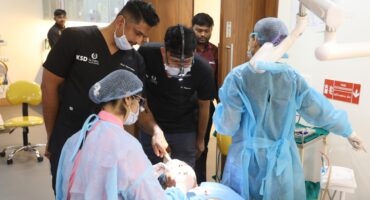
Full-arch implant dentistry should not be attempted without mentorship and proper training. During our Clinical Residency and All-on-4® training in Perth, we guide clinicians step-by-step through the following:
- CBCT evaluation
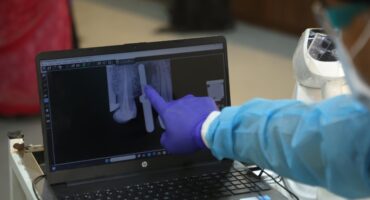
- Digital planning
- Bone reduction design
- Implant angulation control
- Guided surgery
- Occlusal design
- Provisional fabrication
- Complication management
This structure prevents common mistakes and accelerates confidence.
Full-arch and All-on-4® treatment represents one of the most life-changing procedures a dentist can offer, but it comes with high responsibility. Complications in full-arch surgery are not only more complex but can be financially and emotionally significant for both clinician and patient.
Understanding these complications is not about inducing fear; it is about developing judgment, maturity, and clinical discipline.
If you are preparing to offer full-arch implants or wish to deepen your confidence with immediate loading, I strongly encourage you to explore advanced training options at the Global Implant Centre. With the right guidance, full-arch rehabilitation becomes predictable, rewarding, and professionally transformative.