By Dr Brijesh Mandli, Lead Mentor, Global Implant Centre. Diplomate and Fellow ICOI, Diplomate GCOI, Fellow ISOI.
Most dentists who decide to take their implant skills seriously end up at the same fork in the road. They know a weekend lecture will not get them there, and they know the next step has to involve real hands-on work. What they are far less sure about is which format suits them. A structured implant fellowship, or an immersive dental implant clinical residency.
The two get talked about as if they were the same thing. They are not. They suit different stages of a clinician’s development, they are built on different teaching philosophies, and picking the wrong one for where you are now is one of the easiest ways to waste both time and money on implant education.
This guide sets out how the two pathways really differ, what each one is built to do, and how to work out which is the right next move for you.
A fellowship is a structured, staged programme. It is designed to walk you through implant dentistry in a deliberate order, building from the fundamentals up to the most demanding full arch cases, with mentorship and certification attached at the end.
At Global Implant Centre the fellowship pathway runs across three tiers, so you can come in at the level that matches where you are and move up as your confidence grows.
The first tier, the Hybrid Implantology fellowship, pairs theory with hands-on patient surgeries. It includes placing at least ten implants, working in a digital workflow, and personalised mentorship, and it finishes with university certification. It suits dentists who want to move from the occasional, slightly nervous implant to real confidence and precision.
The second tier, the Advanced Implantology and Augmentation fellowship, brings in the procedures that separate a competent implant dentist from an advanced one. Bone and soft tissue augmentation, managing compromised sites, and more involved case planning are the focus. It is aimed at clinicians ready to stop referring their harder cases out and start handling them predictably themselves.
The third tier, the Full Arch and Beyond fellowship, is about full arch rehabilitation. It covers digital workflows, live patient training, and advanced surgical protocols for the toughest presentations, and it is built for experienced clinicians who want to deliver complete, fixed full arch work to a high standard.
What defines the fellowship route is structure. You are not parachuting into a single procedure on its own. You are taken through a curriculum, with theory, mentorship and certification built around the clinical work. A recognised credential of this sort is also what bodies such as the International Congress of Oral Implantologists (ICOI) formalise through their fellowship and diplomate pathways.
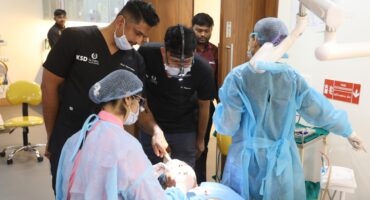
A clinical residency starts from a different place. Rather than building a curriculum around you, it puts you straight into supervised treatment of live patients and lets the clinical work itself do the teaching. The emphasis is on volume, repetition, and real decisions made in real time with an experienced mentor at hand.
That is the heart of the live patient clinical residency at Global Implant Centre, which mirrors the fellowship tiers so the depth of immersion matches your level.
The Fundamental Implantology externship builds your foundation by having you carry out essential implant procedures on live patients. The focus is confidence in diagnosis, planning and execution, all under close supervision. For a lot of dentists this is the point implant dentistry stops being theoretical and starts feeling like something they can actually do.
The Advanced Implantology and Augmentation externship moves into advanced surgical techniques, including bone and soft tissue augmentation, in a real clinical setting. It is for clinicians ready to take on complex cases rather than read about them.
The Full Arch externship gives you immersive, hands-on full arch experience, from digital workflows through surgical protocols to the prosthetic side, so that handling a full case becomes something you have done rather than only watched.
What defines the residency route is immersion. You learn by treating patients, over and over, with someone beside you to catch and correct things as they happen.
Both routes involve real patients and real mentorship, so the split is not as simple as theory against practice. The real differences are about emphasis and what you come away with.
A fellowship is curriculum led. It moves through a planned sequence, balances understanding with clinical work, and ends in a formal credential. It is the better fit when you want a recognised qualification and a complete, staged grounding rather than exposure to one area.
A dental implant clinical residency is case led. It puts depth of hands-on exposure first, along with the judgement that only comes from treating a lot of patients. It is the better fit when your theory is already sound but your hands and your nerve have not caught up, and what you need most is supervised repetition.
There is also a difference in what each one guards against. A fellowship guards against gaps in your knowledge, because it sets out to cover the whole picture. A residency guards against the more common problem of knowing what to do in theory and then freezing when a real patient is in the chair.
The honest answer is that it depends almost entirely on where you are right now.
If you are fairly early in your implant journey and you want a complete, credentialed grounding rather than a patchwork of short courses, the structured fellowship route is usually the better place to start. It gives you the theory, the mentorship and the certification in one programme, beginning with the Hybrid Implantology fellowship.
If you already grasp the principles but do not have the hands-on mileage to feel genuinely confident, a clinical residency will serve you better. That supervised, high volume live patient experience is exactly what turns theory into competence, and the Fundamental Implantology externship is built for that step.
If your goal is specifically full arch and all-on-4 work, both routes have a dedicated full arch tier, and the right one depends on whether you want the structured, certified path or the immersive, high volume one. Our guide to full arch and all-on-4 training goes through that choice in more detail.
And if you are still unsure, it helps to remember the two are not mutually exclusive. Plenty of dentists use a fellowship to build a complete, certified base, then use a residency to pile up hands-on volume in the area they most want to master. Together they answer the two halves of the same question. Do you know enough, and have you done enough?
Whichever route you take, the thing that decides how much you get out of it is the quality of the mentorship. A good curriculum and a high volume of cases are both worth far less without an experienced clinician working through them with you.
That is why both routes at Global Implant Centre are built around direct mentorship from clinicians who place and restore implants every week, full arch and complex augmentation included. The point is not to let you watch advanced dentistry happen. It is to put you in the operator’s chair, with the support to do it safely and the feedback to get better quickly.
If you would like to talk through which route suits your current level before committing, that conversation is usually the most useful first step of all.