By Dr Brijesh Mandli, Lead Mentor, Global Implant Centre. Diplomate and Fellow ICOI, Diplomate GCOI, Fellow ISOI
Most general dentists who place implants will, sooner or later, sit across from a patient with a failing dentition and know exactly what that person needs. A fixed, full arch solution. And in that moment, most of us refer the case out.
Referring is not a failure, and there is a place for it. But it is worth being honest about what leaves with that referral. A high value treatment, a patient who might have stayed with the practice for years, and a real piece of revenue, all of it walking out the door and rarely coming back. Over a career that adds up. In my experience the dentists who learn to keep those cases are rarely the most naturally gifted in the room. They are the ones who committed to proper full arch implant training and saw it through.
This article is about what that decision actually involves. What full arch asks of you, why it is riskier than single unit work, and how to build the skill to offer it safely rather than learning the hard way on your own patients.
Full arch rehabilitation, including all-on-4 and all-on-6 style treatment, sits right at the top of implant dentistry. It changes a patient’s life in a way few other procedures manage, it carries a fee that reflects that, and demand keeps climbing as more people look for a fixed alternative to dentures. The all-on-4 approach in particular is now a well established full arch protocol with high long term implant survival, which is a large part of why patients keep asking for it by name.
Bringing full arch in house also changes the economics of a practice. The complex, valuable cases you used to send away start to stay with you. Over time you stop being the practice that refers full arch out and become the one other dentists refer their full arch cases to. That is a genuine shift in standing, and it is worth working towards.
None of that changes the fact that full arch is demanding. It is not a procedure to walk into casually.
A single implant in a healed site is a fairly contained job. Full arch is a different kind of challenge altogether, and the size of that gap tends to catch people off guard before they attempt it.
Full arch usually means placing several implants in a precise relationship to one another, often tilting the back implants to avoid the sinus and to find anchorage in the bone that is actually available, without grafting. It often means immediate loading, where the provisional bridge goes in within days, which leaves very little room for an implant that ends up in the wrong position. The prosthetic side asks just as much of you. Accurate records, careful control of the bite, and a clear sense that the final restoration should be driving the surgical plan, not the other way round.
Any one of those things can go wrong on its own, and in full arch they tend to stack on top of each other. An angulation error you would shrug off in a single unit case can put a whole arch at risk. That is why training counts for so much here, and why teaching yourself as you go is so expensive. If you want a sense of what can go wrong and why, our article on complications in full arch and all-on-4 implant treatment makes a good companion to this one.
Full arch is not a single skill. It is a handful of them that have to work together reliably before you treat your first case without supervision.
Surgically, you need to read bone with confidence, plan implant positions across the arch, place tilted implants accurately, and reach the primary stability that immediate loading depends on. On the restorative side you are handling records, vertical dimension, and the move from a provisional to a final prosthesis. Holding all of it together is the digital workflow, from CBCT planning and intraoral scanning through to guided placement, which has probably done more than anything else to make full arch predictable.
A committed general dentist can learn every part of this. The catch is that it has to be learned in the right order, ideally with someone experienced at your shoulder, because any gap usually shows up in the patient’s mouth rather than in yours.
The thing to be honest about is that full arch is not where you start. The dentists who do well with it almost always arrive having already done the groundwork on single implants, and usually on augmentation too.
A sensible path runs roughly like this. First you get genuinely comfortable and predictable with single implants, in healed sites and then in fresh sockets. Then you build your ability to manage bone and soft tissue, because full arch leans on it constantly. Only after that do you take on full arch itself, where every one of those skills is needed at the same time and the clock is ticking. Skipping that order is, in my experience, the single most common reason full arch cases come unstuck in less experienced hands. Working out where you honestly sit is really a matter of sound case selection, and it pays to be candid with yourself about it.
If the answer is that you are not there yet, that is worth knowing rather than something to feel bad about. It tells you what to work on next.
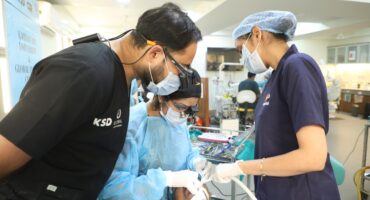
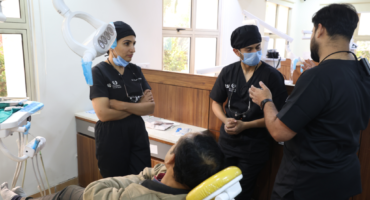
This is where the kind of training you choose really matters. A lecture course can give you the theory of full arch, but it cannot give you the part that actually builds competence, which is doing the surgery on real patients with someone experienced beside you. Watching full arch and performing it are nothing like the same experience, and that gap is widest in cases this complex. I have written elsewhere on why hands-on training tends to beat lecture-based CPD, and full arch is the clearest example of it I know.
At Global Implant Centre we build full arch training around that idea. The Advanced Full Arch Implant program is a hands-on surgical course where you carry out real full arch cases and work on advanced anchorage techniques with guidance, and the next intake runs from 6 to 11 July 2026. If you would rather take the structured, certified route, the Full Arch and Beyond fellowship covers digital workflows, live patient training and advanced surgical protocols as part of a staged programme. And if what you want is the most time with live cases, the Full Arch live patient externship is built around exactly that.
If you are still weighing the structured route against the more immersive one, our guide to choosing between a fellowship and a clinical residency walks through that decision properly. Whichever you choose, the principle holds. Your first full arch case is not one to do alone. Do it next to someone who has done hundreds.
Full arch training costs real time and real money, so it deserves a careful look. The clearest way to think about it is return. One full arch case kept in your practice instead of referred away can cover a good part of the course on its own, and the training tends to pay for itself across a handful of cases. Beyond the fees, offering full arch lifts how you are seen, brings in more complex and higher value patients, and turns your practice into the place that takes the cases others cannot. I go into that in more depth in our piece on whether advanced implant training is worth the investment.